Flooring Guide
How Much Carpet Do I Need?
Calculating carpet is a little different from calculating laminate, vinyl plank, hardwood, or tile.
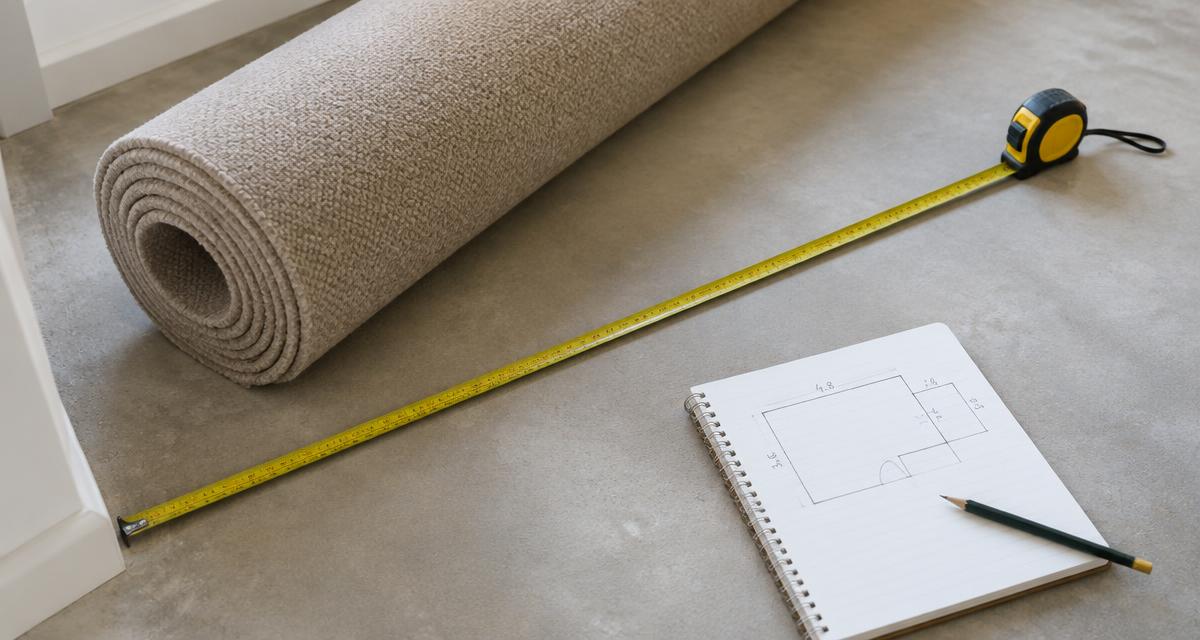
The first step is still to measure the floor area, but square footage alone does not always tell you how much carpet to buy.
Broadloom carpet is supplied in fixed roll widths. Most residential carpet is commonly available in widths such as 12 feet, while some products are available in other widths. If your room is wider than the carpet roll, or if the best layout requires a seam, you may need more carpet than the room's exact square footage.
Patterned carpet can require additional material as well because the pattern may need to line up where pieces are joined.
The best carpet calculation therefore considers:
- room length and width
- carpet roll width
- seam placement
- carpet direction
- pattern repeat
- closets and connecting spaces
- stairs, if included
You can estimate your project automatically using the BuildCalcWorks Carpet Calculator, or follow the steps below to understand how carpet quantity is calculated.
How to Calculate How Much Carpet You Need
For a simple room, start by calculating the floor area:
Room Area = Length × Width
However, it does not necessarily mean you can buy exactly 180 square feet of carpet.
Because broadloom carpet comes in a fixed roll width, you need to determine how a section of that roll can be cut to cover the room.
Step 1: Measure the Room
Measure the room at its longest and widest points.
Do not assume opposite walls are perfectly parallel or that the room dimensions shown on a plan are exact.
For a rectangular room:
Room Area = Length × Width
If you need more help measuring flooring areas, see: How to Calculate Square Footage for Flooring
Step 2: Check the Carpet Roll Width
Broadloom carpet is manufactured in fixed widths.
A common residential width is:
12 ft
Some products may also be available in widths such as:
13.5 ft
or:
15 ft
The exact width depends on the carpet product.
Always verify the roll width of the carpet you plan to buy.
This width can have a major effect on the amount of material required.
Why Carpet Roll Width Matters
This difference occurs because the carpet must be cut from the full roll width.
That is why estimating carpet by room square footage alone can underestimate the actual amount required.
Basic Carpet Roll Formula
If one piece of carpet can cover the room:
Carpet Piece Area = Roll Width × Required Cut Length
Complete Carpet Example — Room Narrower Than the Roll
Suppose a bedroom measures:
11 ft × 15 ft
Carpet roll width:
12 ft
Additional installation allowance may also be required depending on measurement and installer requirements.
What Happens If the Room Is Wider Than the Carpet Roll?
Suppose a room measures:
15 ft × 18 ft
but the carpet roll is:
12 ft wide
One 12-foot-wide piece cannot cover the full 15-foot width.
The installation will normally require more than one piece and at least one seam, unless a wider carpet product is selected.
This means the carpet layout becomes important.
A professional estimator may decide how to arrange the pieces based on:
- room dimensions
- traffic direction
- doorways
- lighting
- pile direction
- seam visibility
- carpet pattern
- roll width
This is one reason large-room carpet estimates can be more complicated than a simple square-foot calculation.
Why Seam Placement Matters
A carpet seam is where two pieces of carpet are joined together.
A good carpet layout attempts to:
- minimize the number of seams
- avoid highly visible locations when possible
- maintain the same pile direction
- account for traffic patterns
- match patterns where required
Changing the seam layout can also change how much carpet must be cut from the roll.
For this reason, two installers could potentially create different cutting plans for the same room while covering the same floor area.
Carpet Direction Matters Too
Carpet generally needs to run in a consistent pile direction.
When carpeting connected rooms, hallways, or large spaces, the direction of the carpet can affect:
- seam placement
- cut lengths
- waste
- visual appearance
It may not be possible to rotate every leftover piece simply because its dimensions fit another area.
The pile and pattern direction also need to be considered.
How Much Extra Carpet Should You Buy?
Unlike plank flooring, there is no single waste percentage that accurately handles every broadloom carpet installation.
You may sometimes hear general allowances such as 5% or 10%, but carpet waste depends heavily on:
- roll width
- room dimensions
- seam layout
- pattern repeat
- carpet direction
- connected rooms
- stairs
- irregular spaces
For carpet, a layout-based estimate is generally better than simply adding a fixed percentage to the room area.
If you are ordering broadloom carpet, verify the final quantity with the retailer or installer before purchasing.
Patterned Carpet Can Require More Material
Patterned carpet may need additional material so that the pattern aligns correctly between adjacent pieces.
This is known as:
pattern matching
Suppose a carpet design repeats every certain distance along the roll.
When two pieces are seamed together, the installer may need to move one piece forward to line up the pattern.
That can increase the required cut length.
The larger the pattern repeat, the more important this becomes.
If you are choosing patterned carpet, check:
- pattern repeat dimensions
- carpet direction
- seam locations
- manufacturer's installation guidance
before calculating the final order.
Why You Should Not Ignore Pattern Repeat
Imagine two carpet pieces need to meet at a seam.
Without a visible pattern, the installer primarily needs to align:
- pile direction
- edges
- seam position
With patterned carpet, the design also needs to match across the seam.
If the pattern does not align naturally at the planned cut point, extra carpet may need to be pulled forward before the second piece is cut.
That additional length can significantly change the amount of carpet required for larger patterned installations.
How Much Carpet Do I Need for Multiple Rooms?
Start by measuring every room receiving the carpet.
However:
334 sq ft is not automatically the amount of broadloom carpet you should order.
The rooms need to be arranged against the available carpet roll width.
The estimator should determine:
- which rooms can use full-width cuts
- whether offcuts can be reused
- pile direction
- seam locations
- pattern matching
- hallway orientation
The final carpet quantity can therefore be higher than 334 square feet.
Can Leftover Carpet from One Room Be Used in Another?
Sometimes.
For example, if a 12-foot-wide carpet roll is used in a 10-foot-wide room, a strip may remain.
That strip could potentially be useful in:
- a small closet
- a landing
- part of another room
- another narrow area
But it is not always reusable.
The leftover piece must also have the correct:
- dimensions
- pile direction
- pattern orientation
- color consistency
Good carpet planning can reduce waste by arranging cuts efficiently across several rooms.
Should Closets Be Included?
Yes, if the closet will be carpeted.
Measure:
- reach-in closets
- walk-in closets
- storage closets
- other carpeted spaces
However, because carpet is cut from full-width rolls, the closet may sometimes be covered using an offcut from the main room.
Do not simply add the closet area and assume that exact additional amount must be ordered.
Include the closet in the overall carpet layout.
Hallways Can Affect Carpet Quantity
Hallways are often narrow compared with standard carpet roll widths.
But cutting a separate full-width 12-foot piece for the hallway could use much more material than 80 square feet.
A good installer may be able to use material remaining from other room cuts.
This is another reason a whole-project carpet layout can be more efficient than calculating every room independently.
Irregular Rooms
For irregular rooms, divide the floor into simple sections to find the actual area.
This gives you a useful starting point.
But broadloom carpet must still be laid out using the available roll width.
Corners and alcoves may create additional offcuts that cannot always be reused.
How Much Carpet Do I Need in Square Yards?
Carpet has traditionally also been measured in square yards.
There are:
9 square feet in 1 square yard
To convert square feet into square yards:
Square Yards = Square Feet ÷ 9
Square Feet to Square Yards Example
If your supplier prices carpet by square yard, this conversion can be useful.
Always confirm whether the quoted price refers to:
- square foot
- square yard
- installed area
- material only
What About Carpet Sold by the Linear Foot?
Broadloom carpet may also be described based on its fixed roll width and linear length.
This illustrates why the roll width matters when converting linear length into actual carpet area.
How Much Carpet Do I Need for Stairs?
Stairs should usually be calculated separately from flat room area.
A stair may require carpet for:
- the tread
- the riser
- wrapping around the nosing
- installation allowance
You also need to know:
- stair width
- tread depth
- riser height
- number of steps
A basic starting point for one closed stair is:
Tread depth + Riser height
multiplied by the stair width.
However, carpet fitting around stair nosings and installation details can require additional material.
Curved, open, winding, or unusually shaped stairs require more detailed planning.
If BuildCalcWorks has a relevant stair or carpet calculation feature available, use that tool for the project-specific estimate.
Carpet Tiles Are Different
Carpet tile quantity is calculated more like other modular flooring products.
For carpet tiles, you can generally:
- calculate the floor area
- calculate the area covered by each tile
- determine the number of tiles required
- add an appropriate waste allowance
This article primarily focuses on broadloom carpet supplied in rolls.
Do not use broadloom roll calculations for modular carpet tiles.
Does Carpet Padding Use the Same Quantity?
Carpet padding or underlay normally needs to cover the same usable floor area, but it is a separate product with its own:
- roll size
- packaging
- seams
- installation requirements
Do not assume that the number of carpet rolls or square yards automatically gives you the exact pad package quantity.
Calculate the pad according to its own product dimensions and coverage.
Should You Add Extra Carpet for Installation?
Professional carpet standards and manufacturers often require small additional amounts beyond the exact room dimension so carpet can be positioned, stretched, trimmed, and fitted properly.
For example, professional installation standards may specify that planned roll lengths extend beyond the measured area.
This is different from simply adding a generic 10% waste factor.
The final cut dimensions should follow the installation plan and installer requirements.
Carpet Installation Example with a 12-Foot Roll
The additional material results from using the full roll width rather than from applying a percentage waste allowance.
This demonstrates why carpet calculations are different from flooring sold by square-foot coverage in cartons.
A Second Example — 15-Foot-Wide Room
A seam will be required unless the carpet can be oriented differently or a wider product is selected.
The final quantity depends on the chosen seam layout.
Simply ordering:
210 sq ft
would therefore be unreliable.
Would a Wider Carpet Roll Reduce Waste?
Sometimes.
If a 15-foot-wide carpet is available for a 15-foot-wide room, the installer may be able to cover the area with one piece.
With a narrower roll, the same room may require a seam and additional cuts.
However, a wider roll does not automatically mean less waste in every room.
The best width depends on:
- room dimensions
- connected rooms
- carpet direction
- pattern
- available product widths
Common Carpet Calculation Mistakes
Buying Only the Room Square Footage
A 200-square-foot room does not necessarily require exactly 200 square feet of broadloom carpet.
Roll width matters.
Ignoring Roll Width
Always check the width of the carpet product.
Automatically Adding 10%
A percentage allowance alone may not account for seams, roll width, or pattern matching.
Forgetting Closets
Include all carpeted spaces in the layout.
Ignoring Carpet Direction
Offcuts cannot always be rotated and reused.
Ignoring Pattern Repeat
Pattern matching can require additional carpet.
Measuring Each Room Without Planning the Whole Project
Several rooms can sometimes be cut more efficiently when planned together.
Forgetting Stairs
Stairs require a separate calculation.
Confusing Square Feet and Square Yards
Remember:
1 square yard = 9 square feet
Ordering Before Confirming the Layout
For large or patterned broadloom projects, verify the final cut plan with the carpet retailer or installer.
For general room-area calculations, you can also use the BuildCalcWorks Flooring Calculator.
Related Calculators
Related Guides
Flooring
How to Calculate Square Footage for Flooring
Learn how to calculate square footage for flooring, measure rooms correctly, account for irregular areas and add waste before ordering flooring materials.
Read guideFlooring
How Much Extra Flooring Should You Buy?
Learn how much extra flooring to buy for cuts and waste, when to use 5%, 10% or 15%, and how to calculate boxes for your flooring project.
Read guideFlooring
How Many Boxes of Laminate Flooring Do I Need?
Learn how to calculate how many boxes of laminate flooring you need using room area, waste allowance and coverage per box, with easy worked examples.
Read guideFlooring
How Many Vinyl Planks Do I Need?
Learn how to calculate how many vinyl planks and boxes you need using room size, plank dimensions, box coverage and waste allowance.
Read guideFlooring
How Much Tile Do I Need?
Learn how to calculate how much tile you need using room area, tile size, box coverage and waste allowance, with easy examples for floors and walls.
Read guideFrequently Asked Questions
Measure the Room — Then Plan the Carpet Layout
The first step in any carpet estimate is measuring the floor.
For a rectangular room:
Length × Width = Floor Area
But broadloom carpet requires another step.
You also need to consider:
- carpet roll width
- cut direction
- seams
- pattern repeat
- connected rooms
- closets
- stairs
That difference is why carpet should not always be ordered using floor square footage alone.
For straightforward rooms, the calculation can be simple. For multiple rooms, large rooms, stairs, or patterned carpet, a full cut layout provides a much better estimate.
For the quickest project estimate, use the BuildCalcWorks Carpet Calculator and confirm the final broadloom layout with the carpet retailer or installer before ordering.
Disclaimer: This guide provides planning information. Actual carpet requirements can vary with roll width, seam layout, pile and pattern direction, product specifications and installer requirements. Verify measurements and the final cut plan before ordering. Read full Disclaimer.