Flooring Guide
How Much Tile Do I Need?
Whether you are tiling a bathroom floor, kitchen backsplash, shower wall, entryway, or an entire room, one of the first questions is: how much tile do I need?
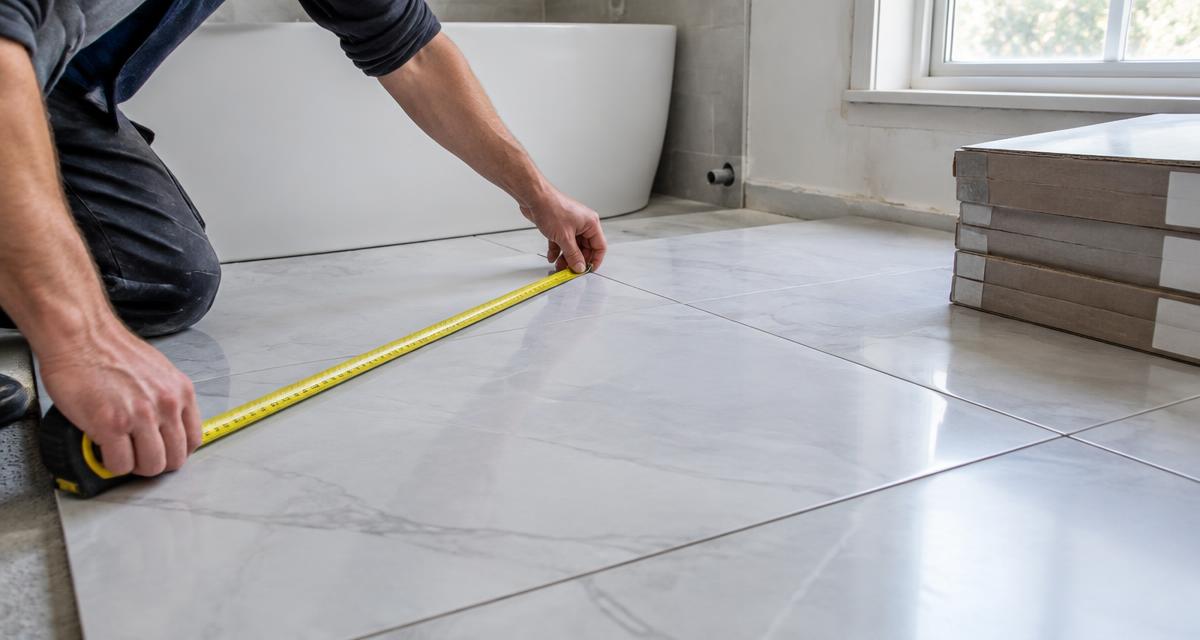
The answer depends on four main things:
- the total area you want to cover
- the size of each tile
- the amount of extra tile needed for cuts and waste
- the coverage per box or carton
The basic process is:
Measure the area → calculate tile quantity → add waste → convert to boxes
For many straightforward tile projects, around 10% extra is a useful planning starting point, but complex patterns, irregular areas, natural stone, or difficult layouts may require more.
You can calculate everything automatically using the BuildCalcWorks Tile Calculator, or follow the steps below.
How to Calculate How Much Tile You Need
The basic tile calculation is:
Tiles Required = Total Area ÷ Area per Tile
However, that is only the starting point.
You should usually add extra tile for:
- cuts
- breakage
- damaged pieces
- pattern matching
- irregular edges
- future repairs
For purchasing, you will often calculate by box coverage rather than individual tile count.
Step 1: Measure the Area
For a rectangular floor or wall:
Area = Length × Width
If the space is irregular, divide it into smaller rectangles, calculate each area separately, and add them together.
If you need help with floor measurements, see: How to Calculate Square Footage for Flooring
Step 2: Calculate the Area of One Tile
To calculate individual tile quantity, you need to know how much area one tile covers.
Tile Area Formula
Use:
Tile Area = Tile Length × Tile Width
Then convert the result into the same unit used for the project area.
If the room is measured in square feet, the tile area must also be expressed in square feet.
If the project is measured in square meters, use square meters throughout.
Step 3: Calculate the Number of Tiles
Use:
Tiles Required = Total Area ÷ Area per Tile
Step 4: Add a Tile Waste Allowance
You should normally order more tile than the exact measured area requires.
Extra tile may be needed for:
- cutting around walls
- corners
- doorways
- fixtures
- cabinets
- plumbing penetrations
- breakage
- damaged tiles
- pattern alignment
- unusual room shapes
- future repairs
For many straightforward projects, around 10% extra is a useful planning allowance.
Simple layouts may need less, while complicated patterns or natural stone installations may require more.
Always check the recommendations for the tile product and installation pattern you are using.
Tile Waste Formula
Use:
Tile Required with Waste = Tile Quantity × (1 + Waste Percentage ÷ 100)
If the result is not a whole number, round upward.
Waste by Project Type
A general planning guide might look like this:
| Tile Project | Example Planning Allowance |
|---|---|
| Simple straight layout | Around 5–10% |
| Typical tile project | Around 10% |
| Irregular area or many cuts | Around 10–15% |
| Diagonal or complex pattern | Often 15% or more |
| Natural stone | Follow product and installer guidance |
These are planning ranges, not universal rules.
The actual amount can vary depending on:
- tile size
- room shape
- pattern
- material
- installer method
- breakage risk
- product recommendations
For more detail, see: How Much Extra Flooring Should You Buy?
Step 5: Calculate How Many Boxes of Tile You Need
Tile is usually sold in full boxes.
If the box gives a coverage figure, use:
Boxes Required = Total Tile Area Required ÷ Coverage per Box
Then round upward.
Always Round Tile Boxes Up
Do not round box quantities down.
Examples:
7.1 boxes → 8 boxes
9.4 boxes → 10 boxes
12.01 boxes → 13 boxes
If the project requires any amount beyond the coverage provided by the lower whole number of boxes, you need the next box.
Complete Floor Tile Example
Suppose a kitchen floor measures:
13 ft × 16 ft
You are using:
12 in × 24 in tiles
You want to include:
10% extra
Each box covers:
16 sq ft
How Many Individual Tiles Are Needed in That Example?
A 12 in × 24 in tile covers:
2 sq ft
Required area including waste:
228.8 sq ft
Calculate:
228.8 ÷ 2 = 114.4 tiles
Round upward:
115 tiles
The actual box quantity should still be based on the product's stated box coverage and package quantity.
How Much Tile Do I Need for a Wall?
The same basic area calculation applies.
Measure:
Wall Width × Wall Height
Should You Subtract Doors and Windows?
For large openings, subtracting their area can make the calculation more accurate.
However, for small openings, some people choose not to subtract them because additional cuts around the opening create waste.
The best approach depends on the project size and layout.
Backsplash Tile Example
How Do You Calculate Tile for an Irregular Area?
Divide the project into smaller simple shapes.
How Does Tile Size Affect Quantity?
Larger tiles cover more area per piece, so fewer individual tiles are required.
For example:
12 × 12 Tile
A 12 in × 12 in tile covers:
1 sq ft
A 100-square-foot area therefore requires approximately:
100 tiles before waste
12 × 24 Tile
A 12 in × 24 in tile covers:
2 sq ft
A 100-square-foot area requires approximately:
50 tiles before waste
24 × 24 Tile
A 24 in × 24 in tile covers:
4 sq ft
A 100-square-foot area requires approximately:
25 tiles before waste
The number of pieces changes, but the total area covered remains the main factor.
Common Tile Size Reference
| Tile Size | Approx. Area per Tile |
|---|---|
| 6 × 6 in | 0.25 sq ft |
| 12 × 12 in | 1 sq ft |
| 12 × 24 in | 2 sq ft |
| 18 × 18 in | 2.25 sq ft |
| 24 × 24 in | 4 sq ft |
These values assume the stated tile dimensions are exact nominal dimensions for calculation purposes.
Always use the actual product specifications when available.
Why Is Box Coverage Better Than Counting Tiles?
Although counting individual tiles is useful, using the manufacturer's stated box coverage is usually easier when ordering.
The box already accounts for:
- tile size
- number of pieces per carton
- packaged coverage
For example, if a box says:
14.7 sq ft per carton
use that value directly when determining how many boxes to purchase.
This reduces the chance of unit conversion and rounding mistakes.
How Much Extra Tile Should You Buy?
The correct amount depends on the installation.
For a basic straight installation in a simple room, a smaller allowance may be sufficient.
For:
- diagonal patterns
- herringbone
- irregular walls
- many corners
- large-format tile
- natural stone
- pattern matching
more extra material may be appropriate.
A common planning figure is:
10% extra
but do not assume that 10% is always correct.
Check product and installer recommendations before placing the final order.
How Does Tile Pattern Affect Waste?
Pattern can significantly change the number of cuts required.
A simple straight grid generally uses material efficiently.
More complex layouts such as:
- diagonal
- herringbone
- chevron
- basketweave
- multi-size patterns
can generate more offcuts.
Manufacturers may provide pattern-specific quantity guidance.
When using a complex pattern, calculate the project using the exact layout rather than relying only on a simple square-foot calculation.
Should You Keep Spare Tile?
Yes, keeping some spare tile can be useful.
A few matching tiles may help with future repairs if tiles later become:
- cracked
- chipped
- stained
- damaged during plumbing work
- removed during renovation
Matching an older tile later can be difficult because:
- products may be discontinued
- dye lots may differ
- printing can change
- stone varies naturally
- finishes can be updated
For that reason, some manufacturers recommend keeping extra material from the original purchase.
Ceramic vs Porcelain vs Natural Stone
The basic quantity calculation is similar for:
- ceramic tile
- porcelain tile
- marble
- travertine
- slate
- other natural stone
However, the waste allowance may differ.
Natural stone can require more sorting, cutting, and selection because of:
- veining
- shade variation
- natural defects
- pattern matching
Always use material-specific guidance for the final order.
Square Feet vs Square Meters
The same process works in metric units.
Imperial
Length in feet × Width in feet = Square feet
Metric
Length in meters × Width in meters = Square meters
Keep your units consistent throughout the calculation.
Common Tile Calculation Mistakes
Forgetting Waste
Ordering exactly the measured area may leave too little material for cuts and breakage.
Using the Wrong Tile Size
Make sure the tile dimensions match the product you are actually buying.
Using the Wrong Box Coverage
Do not assume every carton covers the same area.
Rounding Boxes Down
A result of:
8.1 boxes
means:
9 boxes
Forgetting Wall Openings or Floor Sections
Measure the actual area carefully.
Mixing Inches and Feet
If tile dimensions are in inches and room dimensions are in feet, convert them before calculating individual tile quantity.
Assuming Every Pattern Uses the Same Amount
Complex patterns may require more tile.
Not Keeping Spare Tile
Future replacement tile may be difficult to match.
For broader floor-area calculations, you can also use the BuildCalcWorks Flooring Calculator.
Related Calculators
Related Guides
Flooring
How to Calculate Square Footage for Flooring
Learn how to calculate square footage for flooring, measure rooms correctly, account for irregular areas and add waste before ordering flooring materials.
Read guideFlooring
How Much Extra Flooring Should You Buy?
Learn how much extra flooring to buy for cuts and waste, when to use 5%, 10% or 15%, and how to calculate boxes for your flooring project.
Read guideFlooring
How Many Boxes of Laminate Flooring Do I Need?
Learn how to calculate how many boxes of laminate flooring you need using room area, waste allowance and coverage per box, with easy worked examples.
Read guideFrequently Asked Questions
Calculate Before You Order
The basic process for estimating tile is straightforward:
- Measure the area.
- Calculate the tile coverage.
- Add an appropriate waste allowance.
- Convert the required area into full boxes.
- Round upward.
Tile layout, material, room shape, and installation pattern can all affect the final amount, so always check the recommendations for the specific tile product before ordering.
For the quickest estimate, use the BuildCalcWorks Tile Calculator to calculate your project automatically.
Disclaimer: This guide provides planning information. Actual material requirements can vary with product packaging, tile size, installation pattern, manufacturer requirements, area shape and material type. Verify measurements and product instructions before ordering. Read full Disclaimer.